dimanche 24 mars 2013

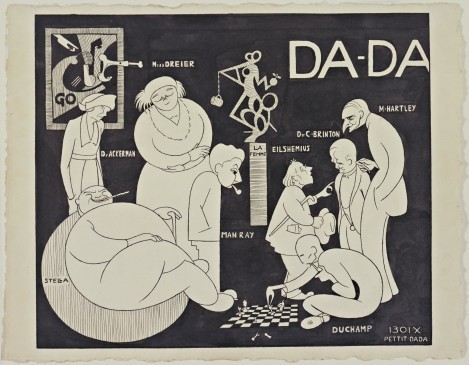
Marsden HARTLEY. The Importance of Being "Dada" (1921)

Marsden Hartley (1877–1943). Handsome Drinks, 1916


Marsden Hartley. The Importance of Being "Dada" (1921)

We are indebted to Tristan Tzara and his followers for the newest and perhaps the most important doctrinary insistence as applied to art which has appeared in a long time. Dada-ism is the latest phase of modernism in painting as well as in literature, and carries with it all the passion for freedom of expression which Marinetti sponsored so loudly in his futuristic manifestos. It adds likewise an exhilarating quality of nihilism, imbibed, as it is said, directly from the author of Zarathustra. Reading a fragment of the documentary statement of Dada-ism, we find that the charm of the idea exists mainly in the fact that they wish all things levelled in the mind of man to the degree of commonplaceness which is typical and peculiar to it.

Nothing is greater than anything else, is what the Dada believes, and this is the first sign of hope the artist at least can discover in the meaningless importance which has been invested in the term ART. It shows best of all that art is to betake itself on its own way blandly, despite the wish of its so ardent supporters and suppressors. I am greatly relieved as an artist, to find there is at least one tenet I can hold to in my experience as a useful or a useless human being. I have always said for myself, I have no office, no obligation, no other "mission", dreadfullest of all words, than to find out the quality of humor that exists in experience, or life as we are entitled to call it. I have always felt the underlying fatality of habit in appreciation, because I have felt, and now actually more than ever in my existence, the fatality of habit indulged in by the artist. The artist has made a kind of subtle crime of his habitual expression, his emotional monotonies, and his intellectual inabilities.

If I announce on this bright morning that I am a "Dada-ist" it is not because I find the slightest need for, or importance in, a doctrine of any sort, it is only for the convenience of myself and a few others that I take up the issue of adherence. An expressionist is one who expresses himself at all times in any way that is necessary and peculiar to him. A dada-ist is one who finds no one thing more important than any other one thing, and so I turn from my place in the scheme of expressionist to dada-ist with the easy grace that becomes any self-respecting humorist.

Having fussed with average intelligence as well as with average stupidity over the various dogmatic aspects of human experience such as art, religion, philosophy, ethics, morals, with a kind of obligatory blindness, I am come to the clearest point of my vision, which is nothing more or less than the superbly enlightening discovery that life as we know it is essentially a comic issue and cannot be treated other than with the spirit of comedy in comprehension. It is cause for riotous and healthy laughter, and to laugh at oneself in conjunction with the rest of the world, at one's own tragic vagaries, concerning the things one cannot name or touch or comprehend, is the best anodyne I can conjure in my mind for the irrelevant pains we take to impress ourselves and the world with the importance of anything more than the brilliant excitation of the moment. It is thrilling, therefore, to realize there is a healthy way out of all this dilemma of habit for the artist. One of these ways is to reduce the size of the "A" in art, to meet the size of the rest of the letters in one's speech. Another way is to deliver art from the clutches of its worshippers and by worshippers I mean the idolaters and commercialists of art. By idolaters I mean those whose reverence for art is beyond their knowledge of it. By the commercialists I mean those who prey upon the ignorance of the unsophisticated, with pictures created by the esthetic habit of, or better to say, through the banality of "artistic" temperament. Art is at present a species of vice in America, and it sorely and conspicuously needs prohibition or interference.

It is, I think, high time that those who have the artistic habit toward art should be apprised of the danger they are in in assuming of course that they hold vital interest in the development of intelligence. It is time therefore to interfere with stupidity in matters of taste and judgment. We learn little or nothing from habit excepting repetitive imitation. I should, for the benefit of you as reader, interpose here a little information from the mind of Francis Picabia, who was until the war conspicuous among the cubists, upon the subject of dada-ism.

"Dada smells of nothing, nothing, nothing.

It is like your hopes: nothing.

Like your paradise: nothing.

Like your idols: nothing.

Like your politicians: nothing.

Like your heroes: nothing.

Like your artists: nothing.

Like your religions: nothing."

A litany like this coming from one of the most notable dada-ists of the day is too edifying for proper expression. It is like a window opened upon a wide cool place where all parts of one's exhausted being may receive the kind of air that is imperative to it. For the present, we may say, a special part of one's being which needs the most and the freshest air is that chamber in the brain where art takes hold and flourishes like a bed of fungus in the dark.

What is the use, then, of knowing anything about art until we know precisely what it is? If it is such an orchidaceous rarity as the world of worshippers would have us believe, then we know it must be the parasitic equivalent of our existence feeding upon the health of other functions and sensibilities in ourselves. The question comes why worship what we arc not familiar with? The war has taught us that idolatry is a past virtue and can have no further place with intelligent people living in the present era, which is for us the only era worth consideration. I have a hobby-horse therefore—to ride away with, out into the world of intricate common experience; out into the arena with those who know what the element of life itself is, and that I have become an expression of the one issue in the mind worth the consideration of the artist, namely fluidic change. How can anything to which I am not related, have any bearing upon me as artist? I am only dada-ist because it is the nearest I have come to scientific principle in experience. What yesterday can mean is only what yesterday was, and tomorrow is something I cannot fathom until it occurs. I ride my own hobby-horse away from the dangers of art which is with us a modern vice at present, into the wide expanse of magnanimous diversion from which I may extract all the joyousness I am capable of, from the patterns I encounter.

The same disgust which was manifested and certainly enjoyed by Duse, when she demanded that the stage be cleared of actors in order to save the creative life of the stage, is the same disgust that makes us yearn for wooden dolls to make abstract movements in order that we may release art from its infliction of the big "A", to take away from art its pricelessness and make of it a new and engaging diversion, pastime, even dissipation if you will; for all real expression is a phase of dissipation In itself: To release art from the disease of little theatre-ism, and from the mandibles of the octopus-like worshipper that eats everything, in the line of spurious estheticism within range, disgorging it without intelligence or comprehension upon the consciousness of the not at all stupid public, with a so obviously pernicious effect.

"Dada is a fundamentally religious attitude analogous to that of the scientist with his eyeglass glued to the microscope," Dada is irritated by those who write "Art, Beauty, Truth", with capital letters and who make of them entities superior to man "Dada scoffs at capital letters, atrociously." "Dada ruining the authority of constraints, tends to set free the natural play of our activities." "Dada therefore leads to amoralism and to the most spontaneous and consequently the least logical lyricism. This lyricism is expressed in a thousand ways of life." "Dada scrapes from us the thick layers of filth deposited on us by the last few centuries." "Dada destroys, and stops at that. Let Dada help us to make a complete clearance, then each of us rebuild a modern house with central heating, and everything to the drain, Dadas of 1920."

Remembering always that Dada means hobby-horse, you have at last the invitation to make merry for once in our new and unprecedented experience over the subject of ART with its now reduced front letter. It is the newest and most admirable reclaimer of art in that it offers at last a release for the expression of natural sensibilities. We can ride away to the radiant region of "Joie de Vivre", and find that life and art are one and the same thing, resembling each other so closely in reality, that it is never a question of whether it shall or must be set down on paper or canvas, or given any greater degree of expression than we give to a morning walk or a pleasant bath, or an ordinary rest in the sunlight.

Art is then a matter of how one is to take life now, and not by any means a matter of how the Greeks or the Egyptians or any other race has shown it to be for their own needs and satisfaction. If art was necessary to them, it is unnecessary to us now, therefore it is free to express itself as it will. You will find, therefore, that if you are aware of yourself, you will be your own perfect dada-ist, in that you are for the first time riding your own hobby-horse into infinity of sensation through experience, and that you are one more satisfactory vaudevillian among the multitudes of dancing legs and flying wits. You will learn after all that the bugaboo called LIFE is a matter of the tightrope and that the stars will shine their frisky approval as you glide, if you glide sensibly, with an eye on the fun in the performance. That is what art is to be, must come to in the consciousness of the artist most of all, he is perhaps the greatest offender in matters of judgment and taste; and the next greatest offender is the dreadful go-between or "middleman" esthete who so glibly contributes effete values to our present day conceptions.

We must all learn what art really is, learn to relieve it from the surrounding stupidities and from the passionate and useless admiration of the horde of false idolaters, as well as the money changers in the temple of success. Dada-ism offers the first joyous dogma I have encountered which has been, invented for the release and true freedom of art. It is therefore most welcome since it will put out of use all heavy hands and light fingers in the business of art and set them to playing a more honourable and sportsmanlike game. We shall learn through dada-ism that art is a witty and entertaining pastime, and not to be accepted as our ever present and stultifying affliction.

From Adventures in the arts: informal chapters on painters, vaudeville and poets. New York: Boni and Liveright, 1921. Pages 247 – 254 : http://sdrc.lib.uiowa.edu/dada/adventures%20in%20the%20arts/index.htm

samedi 8 décembre 2012

James Panero. « The Armory Show at 100 »


James Panero. « The Armory Show at 100. The lessons of the 1913 International Exhibition of Modern Art. », The New Criterion, December 2012

For a century, the 1913 “International Exhibition of Modern Art,” better known as the Armory Show, has served as a shorthand in the history of taste. Here is the exhibition that dazzled American provincialism with European sophistication. Here is the event that delivered American culture, kicking and screaming, to the world stage. Here is the moment that separates the reactionary past from the more enlightened present. We may remember little about the barnstorming tour that brought the latest paintings of Duchamp, Picasso, and Matisse—along with up to 1,200 other works—to New York, Chicago, and Boston, but we know enough not to make the same mistakes again. No longer will the avant-garde be dismissed, will progressive cultures be ridiculed, or will the masterpieces of contemporary art remain unrecognized. These have been the lessons of 1913. We are all Armorists now.

The centenary of the Armory Show should put these assumptions to the test. The year 1913 was more than the unofficial start of the twentieth century. It was a highpoint in both European and American cultural innovation. While the historic exhibition of the Armory Show contained some of the most advanced paintings and sculptures coming out of Paris, its most radical feature was the show itself, an American creation with an ambition, foresight, and appreciation of these developments that has yet to be duplicated. “No single event, before or since, has had such an influence on American art,” wrote the Whitney Museum director Lloyd Goodrich at the time of its fiftieth anniversary. Another fifty years on and this claim has only been confirmed.

The centenary will be a time to reflect not only on what we’ve learned over the past century but also on what we’ve forgotten, a reconsideration that is already underway. Starting December 6, WNYC radio will air a series of specials on the “culture shock” of 1913 featuring a broad survey of this annus mirabilis, from an 1963 interview with Milton W. Brown, who published his Story of the Armory Show around the fiftieth anniversary, to a consideration of Stravinsky’s Rite of Spring, to a colloquy on the zipper, invented in 1913 in Hoboken, New Jersey.

Just as the fiftieth anniversary of the Armory Show inspired impressive memorial exhibitions, at least two shows have been planned to coincide with the centenary. Opening on February 17, 2013—a hundred years to the day from the Armory’s inauguration—The Montclair Art Museum will launch “The New Spirit: American Art in the Armory Show, 1913,” an exhibition that will examine the Armory’s under-appreciated American art, which represented two-thirds of the original New York display. Then in October, The New-York Historical Society will mount a retrospective featuring over seventy-five works as well as materials about the history of the early Teens. The show will be paired with a catalogue promising thirty-one essays on the 1913 exhibition. While the Armory Show may now be only a vague historical event, by the end of 2013 we should all have given it a thorough reconsideration.

In the first decade of the twentieth century, the cultural atmosphere of the United States, and of New York in particular, where the creative forces of the Armory Show took shape, shared more with the progressive developments of Europe than is often acknowledged. New, modern forms of art that broke with the salon styles of the academies developed in parallel on both sides of the Atlantic.

In 1908, a group of realist painters known as The Eight, all from Philadelphia, all ex-newspaper artists, exhibited together in a sensational show in New York that challenged the refinement of academic painting with a journalistic eye and “paint as real as mud.” Five of these artists—Robert Henri, George Luks, William Glackens, John Sloan, and Everett Shinn—became derisively known as The Ash Can School. A sixth member of The Eight, more of an idealist than a realist, was Arthur B. Davies, who went on to become the impresario of the Armory Show five years later.

At the same time, Alfred Stieglitz was showing both American and European modernist painting and sculpture at The Little Galleries of the Photo-Secession, at 291 Fifth Avenue, better known simply as “291.” In what Marsden Hartley called “probably the largest small room of its kind in the world,” Stieglitz mounted the first exhibitions in America of Henri Matisse, Henri Rousseau, Paul Cézanne, Pablo Picasso, Francis Picabia, Constantin Brancusi, as well as African sculpture. He also gave the first one-man shows to the early generation of American modernists, including Alfred Maurer, John Marin, Marsden Hartley, Arthur Dove, Arthur B. Carles, Oscar Bluemner, Elie Nadelman, Georgia O’Keeffe, and Stanton Macdonald-Wright.

Although the realists and modernists were often at odds, the two American movements shared a dislike for the National Academy and New York’s circle of academicians, which controlled the city’s artistic establishment. With their record of off-the-grid exhibitions, the two camps developed a communal do-it-yourself spirit. In late 1911, several of these independent artists (including some academicians) came together to start an association that could serve as an alternative to the Academy and exhibit “the works of progressive and live painters, both American and foreign,” as this new “Association of American Painters and Sculptors” (AAPS) announced in its mission statement. “We do not believe that any artist has discovered or ever will discover the only way to create beauty.” Recognizing “the new spirit,” the association sought to “lead the public taste in art rather than to follow it.”

Arthur B. Davies, the association’s president, was a charismatic fundraiser and leader. Curiously, his charms also allowed him to carry on a bigamist relationship with two families that did not know about the other until his death in 1928. As the head of the AAPS, Davies became a “dictator, severe, arrogant, implacable,” the painter Guy Pène du Bois later remembered. He also drove the association’s remarkable accomplishments as both its heart and soul. For the inaugural (and only) exhibition of the AAPS, he thought big.

In 1912, Davies saw a catalogue for the Cologne Sonderbund Show, an historic survey of over six hundred modernist works, and decided he wanted a similar version for himself. Because of another commitment, he sent the association’s secretary, the painter Walt Kuhn, to Germany to investigate, advising him at the dock, “go ahead, you can do it.” Kuhn arrived in Cologne on September 30, the last day of the exhibition, and quickly took in this survey of Van Gogh, Cézanne, Gauguin, Signac, Picasso, and Munch. The swift assembly of the Armory Show had begun.

Later in November, Davies met up with Kuhn in Paris. Here, in a little over a week, the two engaged in a tour of the city’s most progressive cultural circles. After visiting the studio of the Duchamp brothers, Davies exclaimed, “That’s the strongest expression I’ve ever seen,” and promoted them extensively during the run of the show. They saw Odilon Redon in his studio, whose work would also be represented and appreciated. (“We are going to feature Redon big. BIG!” Kuhn exclaimed). When they visited Brancusi his studio, Davies said “That’s the kind of man I’m giving the show for” and bought a sculpture on the spot.

All of these introductions came by way of Walter Pach, an unofficial American member of the AAPS living in Paris. Through recent studies, in particular Walter Pach (1883–1958): The Armory Show and the Untold Story of Modern Art in America, by Laurette E. McCarthy, Pach’s full influence has only recently been acknowledged. Pach was the brains of the show. His eye and his connections secured the European components of the exhibition. He was also the key interpreter for the French avant-garde. He translated excerpts of Gauguin’s Noa Noa, the painter’s Tahitian journal, in one of the many widely distributed publications created for the show. His later translation of Eugène Delacroix’s Journal, published by Crown in 1948, is a modern classic.

Pach introduced Davies and Kuhn to the Stein family, those great American collectors of the avant-garde, who provided their own trans-Atlantic connections for the exhibition. They also demonstrated, like Pach, how modernism never developed in full isolation from the United States; even in Paris, it was as much international as it was French. Pach further persuaded Paris’s dealers to participate in the American exhibition. Ambroise Vollard, Durand-Ruel, Félix Fénéon of Bernheim-Jeune, Galerie Emile Druet, and Daniel-Henry Kahnweiler lent much of the work to the show, which was supplemented by loans from American private collections and the artists themselves. The more historical paintings by the Impressionists, the post-Impressionists, and the Nabis—work that already enjoyed a robust European market—satisfied Davies’s desire to show the continuity of modern art, from Goya to the Cubists. For its creators, the Armory Show was about the evolution, rather than the revolution, of art.

All the while, Davies and Kuhn were arranging the logistics of the exhibition. For the New York show, Kuhn rented the recently constructed 69th Regiment Armory from the National Guard for $5,000, plus $500 for expenses. This building, which remains in service today on Lexington Avenue between 25th and 26th Streets, gave the Armory Show its unofficial name. At approximately 2200 percent inflation since 1913, that cost of the venue alone was over $128,000 in today’s dollars, a huge amount for a newly formed artist association. Davies found the money. In a matter of days, the AAPS divided the massive open space into twenty-eight octagonal cubicles and filled it with bunting and greenery that had been donated by Gertrude Vanderbilt Whitney and her sister-in-law, Dorothy Straight. Kuhn, a master of publicity, built up the event even before the first patrons opened. Then, for less than a month, starting on February 17, 1913, the Armory Show became the school, the square, and the sensation of New York.

No admirer of modern art can help but dream of walking through those galleries. “Anyone with a drop of collector’s blood in his veins must develop a retrospective itch to have been there and had the same chance at prescience,” writes Milton Brown in his history. Consider the masterpieces that passed through those doors: View of the Domaine Saint-Joseph (1887), alternatively called Colline des pauvres or “The poorhouse on the hill,” by Cezanne, now in the Metropolitan Museum of Art; Models (1888), by Seurat, now in the collection of The Barnes Foundation; Blue Nude (Souvenir of Biskra) (1907), by Matisse, now at the Baltimore Museum of Art; The Red Studio (1911), by Matisse, now in New York’s Museum of Modern Art; The Garden of Love (1912), by Kandinsky, now at the Metropolitan Museum; and, most famously, Nude Descending a Staircase (1912), by Marcel Duchamp, now at the Philadelphia Museum of Art.

What’s even more remarkable than the presence of these paintings—some of them barely dry—is the prescience of the visitors who saw them. We may not have a time machine to take us back to the Armory Show, but many of those who flocked to the exhibition found a machine that took them into the future. Mentored by Davies and Kuhn at the show, Lillie Bliss eventually assembled the twenty-six Cézannes that formed the nucleus of MOMA. Alfred Stieglitz purchased five drawings by Alexander Archipenko, a drawing by Davies, a statuette by Manolo (one of several artists there who never became a household name), and the exhibition’s only Kandinsky, which he donated to the Metropolitan. The Louise and Walter Arensberg Collection, now at the Philadelphia Museum of Art, contains three of the Duchamps that were at the show, including Nude Descending a Staircase (originally purchased at the fair by the San Francisco–based lawyer Frederic C. Torrey). Katherine Dreier formed the Collection for the Société Anonyme, now at the Yale University Art Gallery, and Arthur Jerome Eddy formed his collection at the Chicago Art Institute.

While most of the work at the Armory would be considered a bargain by today’s standards, not everything was cheap. The Cézanne purchased by the Metropolitan was listed at $8,000 and sold for $6,700—or, adjusted for inflation, about $150,000 today. All told over its entire run, the Armory Show sold 35 American paintings and sculptures (for $11,625 total), 130 foreign works (for $12,886 total), and 205,000 tickets, leaving it with a slight profit at the end of its exhausting three-city run.

This is all not to suggest The Armory Show was universally embraced. While the New York press was generally favorable, often full of praise save for some cranky responses from the city’s establishment critics, the show’s reception at its next stop, The Art Institute of Chicago, was far less gleeful. The Institute’s academic student body staged public protests during the exhibition and even burned in effigy the figure of Walter Pach. Today this display sounds gruesome, but I suspect at the time it was meant to be somewhat jocular. Pach, after all, never went into hiding during his stay in the Land of Lincoln. In fact, this free publicity helped boost the Chicago run of the show, a smaller version of New York stripped of its American art component. At 100,000, Chicago had the highest attendance numbers of all three venues, compared to 87,000 in New York. At only 17,000, Boston proved to be a disappointing third stop in late April, one that says much about the “Brahmin mind,” writes Brown, and the city’s cultural passivity.

The Chicago press largely vilified the show, calling it “profane,” “blasphemous,” “obscene,” “vile,” “suggestive,” and a “desecration.” But Chicago also saw some of the Armory’s most eloquent defenders, in particular Harriet Monroe in the Sunday Tribune. “In a profound sense these radical artists are right,” she observed. “They represent a search for new beauty, impatience with formulae, a reaching out toward the inexpressible, a longing for new versions of truth observed.”

The excitement around the show, both in New York and Chicago, both positive and negative, speaks to the broad conversation the culture of art enjoyed in 1913. The heated response paralleled the modernist experience in Europe, where the 1913 Paris premiere of The Rite of Spring degenerated into a riot. “Of course controversies will arise,” predicted Davies, “just as they have arisen under similar circumstances in France, Italy, Germany, and England.” The responses were often colorful, for example the famous descriptions of Duchamp’s Nude as a “lot of disused golf clubs and bags,” an “orderly heap of broken violins,” “a staircase descending a nude,” and most famously “an explosion in a shingle factory.” Even former President Theodore Roosevelt took part. There is “no requirement that a man whose gift lay in new directions should measure up or down to stereotyped and fossilized standards,” he wrote in his own mixed review of the show, but the “lunatic fringe was fully in evidence.”

There is a reason that such an exhibition, with such energy, has never been repeated. We like to think we live in a post-Armory age, but we rather seem to be locked in a pre-Armory moment. Today our own cultural establishment announces its agenda with auction headlines. A professionalized museum class dictates the story of art to an increasingly passive public. A hundred years ago, the artists of the age said enough to their own academic culture. Without any government, academic, or institutional support, they found like-minded souls who helped nurture and propagate a renewed vision for culture. “Something is wrong with the world,” observed the banker James A. Stillman after seeing the Armory Show in New York. “These men know.” The Armory successfully cast aside “the dry bones of a dead art,” wrote Alfred Stieglitz. We should be so lucky if today’s academic thinkers similarly become the footnotes of history, and a resurgence in art once again captures the vital spirit of the times.

James Panero is the Managing Editor of The New Criterion.

SOURCE : http://www.newcriterion.com/articles.cfm/The-Armory-Show-at-100-7494

mercredi 18 juillet 2012

Remedios VARO (I)


Issue d'un des plus grands mirages qui auront marqué notre vie, se soldat-il par un désastre – la guerre d'Espagne – je suis placé pour revoir auprès de Benjamin Péret retour de Barcelone, Remedios qu'il en ramène. La féminité même, ici en hiéroglyphe le jeu et le feu dans l’oeil de l’oiseau, celle que je tiens (il faut voir contre quels vents et marées) pour la femme de sa vie. L’œuvre de Remedios s’est accomplie au Mexique, en grande partie après leur séparation, mais le surréalisme la revendique tout entière. De son dernier tableau, peint en 1963 peu avant sa mort et reproduit ci-après, son très digne et dernier compagnon Walter Gruen a recueilli de sa bouche le commentaire: « Le mouvement part d’en bas, de la nappe, pour se communiquer au reste. Quelques fruits, sortis de leurs orbites, se heurtent entre eux mais déjà de leurs semences naissent de nouvelles pousses » - La toile s'intitule « Nature morte ressuscitante », ce qui se passe de commentaire et pour nous, quant à elle aussi, veut tout dire.


André Breton, La Brêche, n°7, décembre 1964.

Voir aussi : http://www.nd.edu/~sweber/art/varo/bibliography.html


http://www.cornermag.org/corner02/page04a.htm

Textual and Visual Strategies in the World of Remedios Varo

Carlota Caulfield (Mills College). « Textual and Visual Strategies in the World of Remedios Varo », Corner, NUMBER TWO / SPRING 1999 : http://www.cornermag.org/corner02/page04.htm

mercredi 4 juillet 2012


Dorothea TANNING, Rainy Day Canapé, 1970
Tweed, upholstered wood sofa, wool, Ping-Pong balls, & cardboard
81.9 x 174 x 109.9
© 2011 Dorothea Tanning Collection and Archive

Dorothea TANNING


Dorothea TANNING, Eine Kleine Nachtmusik, 1943, 40,7 X 61, London, Tate


Dorothea Tanning passed away on January 31, 2012
in New York City. She was 101 years old, and had just published her second book of poems,
Coming to That.

This website aims to serve as an introduction and tribute
to Dorothea Tanning’s extraordinary life and work as both
a visual artist and a poet. It is an ongoing project of
The Dorothea Tanning Foundation, which is dedicated to preserving the artist’s legacy.

In Loving Memory of Frida KAHLO....


In Loving Memory of Frida Kahlo....
(1907 - 1954)